
Global Hantavirus Outbreak Tracker & Live Map
The 2026 Hantavirus Outbreak

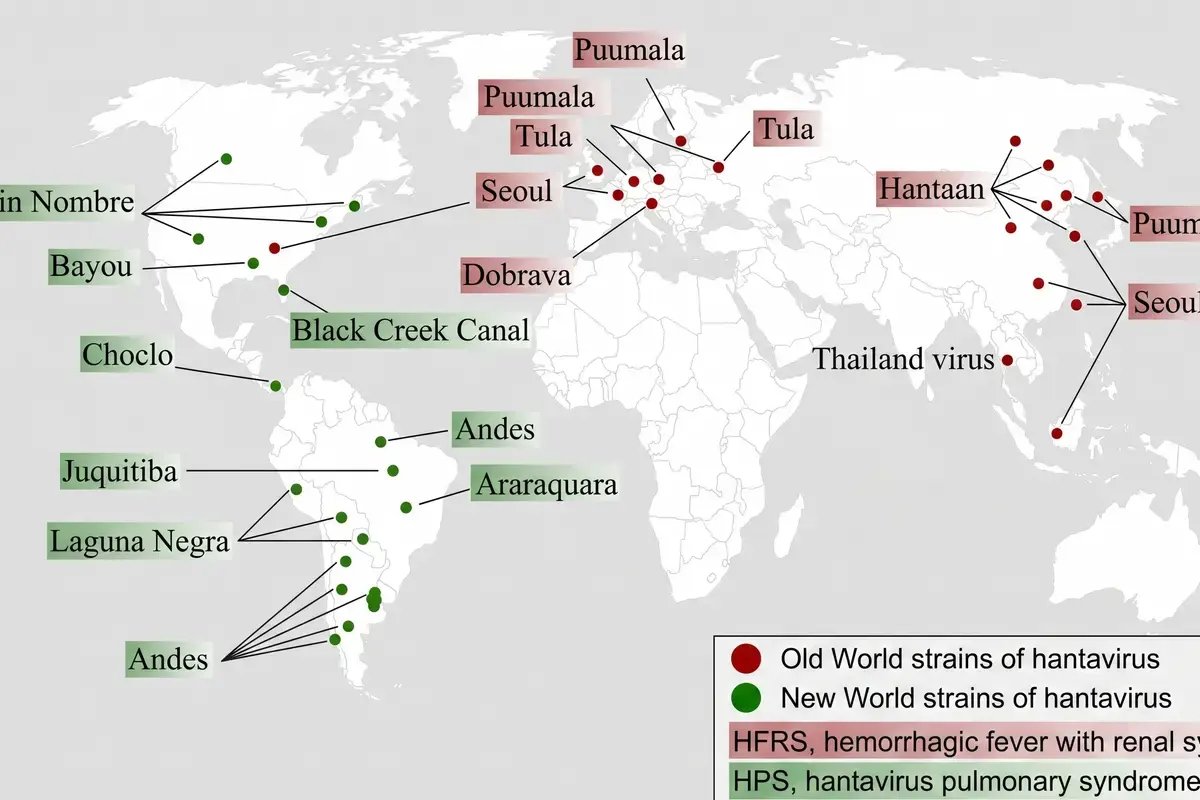
Cluster of severe respiratory illnesses reported aboard the MV Hondius, a Dutch expedition cruise ship. Three passengers died before WHO was formally notified.
WHO formally notified. Lab tests confirmed Andes virus (ANDV) — the only hantavirus known to spread person to person.
WHO confirmed at least 9 cases across multiple countries, with 2 additional suspected. Passengers dispersed to 8+ countries.
The index case most likely acquired the infection during outdoor activities in Argentina before boarding. From there, human-to-human transmission occurred onboard among close contacts.
Passengers dispersed to 8 or more countries after disembarking. The hantavirus map tracked their movements in real time, pulling data from WHO Disease Outbreak Notices and National IHR Focal Point reports. In the US, monitored contacts appeared in California, Arizona, Texas, Kansas, Maryland, New Jersey, Washington, Virginia, and Nebraska. An unrelated suspected case in Illinois added further complexity.
WHO Director-General Dr. Tedros assessed the situation clearly: more cases were possible given the virus's long incubation period. The recommended monitoring window for ANDV exposure is 42 days.
2026 Timeline
Latest events from the 2026 hantavirus outbreak
2026-05-12
Spanish case confirmed in hospital; 12 Nijmegen workers in isolation
A Spanish passenger who tested positive on May 11 was confirmed symptomatic and hospitalized on May 12. Separately, 12 healthcare workers at Radboud University Medical Center in Nijmegen, Netherlands, were placed in isolation after failing to comply with infection control protocols when treating a hantavirus patient.
2026-05-11
French national very critical; MV Hondius departs Tenerife
WHO confirmed the French patient was in very critical condition. The MV Hondius departed Tenerife at approximately 20:00 WET with 25 remaining crew and 2 RIVM medics aboard, heading for Rotterdam for full decontamination.
2026-05-10
MV Hondius docks at Tenerife; 7 evacuation flights depart
The MV Hondius arrived at Port of Granadilla around 05:30 WET. Passengers disembarked by speedboat directly to the airport with no contact with island residents. By late May 10, seven evacuation flights had taken off, transporting 94 passengers to six European countries and Canada.
How Hantavirus Spreads
Aerosolized Particles
Inhaling dried particles from infected rodent urine, droppings, or saliva. Sweeping, digging in contaminated soil, or entering an enclosed area with dried droppings puts you at risk.
Surface Contact
Touching contaminated surfaces and then touching the face. Rodent bites are documented but rare.
Andes Virus (ANDV)
The only hantavirus with confirmed human-to-human transmission. Close, prolonged contact required. This is why the 2026 cruise ship cluster spread onboard but has not triggered wider community transmission. WHO and ECDC both note that brief or casual contact is not sufficient.
The hantavirus map flags Andes virus clusters separately. Any location showing ANDV activity is treated with a distinct risk indicator, given this unique transmission property.
The incubation period ranges from one to eight weeks. The median for HPS is two to four weeks. ANDV can take up to six weeks. This long window is why contact tracing after exposure is difficult, and why the hantavirus map continued showing new locations weeks after the initial outbreak.
Hantavirus Symptoms: What to Watch For
Early hantavirus symptoms look like the flu. That is the problem. Most people wait too long.
Prodromal Phase
Flu-like. No cough. No shortness of breath. That comes later.
- High fever, often above 38.5°C (101.3°F)
- Severe muscle aches in thighs, hips, and lower back
- Intense fatigue and headache
- Nausea, vomiting, or diarrhea in some cases
Cardiopulmonary Phase
HPS only. Respiratory failure can develop within hours.
Fluid accumulates in the lungs. Oxygen levels drop. The heart becomes unstable. Mechanical ventilation is often required. Some patients need ECMO to survive. This window moves fast.
For HFRS: For HFRS: the crisis focuses on the kidneys instead. Hemorrhaging, renal failure, and low platelet counts follow the initial fever phase.
If you have recently traveled through a region marked on the hantavirus map and develop fever with severe muscle pain, seek medical attention immediately. Tell the clinician where you have been. Do not wait for respiratory symptoms to appear.
Hantavirus Prevention and Treatment
Reduce Rodent Exposure
- Seal gaps in buildings. Mice can enter through a hole the size of a dime.
- Store food and garbage in sealed, rodent-proof containers.
- Ventilate any space showing rodent activity for at least 30 minutes before entering.
- Wear rubber gloves and an N95 respirator when cleaning contaminated areas.
- Wet droppings with a 10% bleach solution before wiping. Never dry sweep. Never vacuum.
CDC publishes a full rodent cleanup protocol for homes and workplaces in endemic areas.
If You Were Exposed
See a doctor right away. Mention your exposure history. Request RT-PCR or serology testing. For ANDV exposure, WHO recommends 42 days of active monitoring.
Treatment
Hospital care is the only option. For HPS: supplemental oxygen, mechanical ventilation, and ECMO. For HFRS: dialysis, electrolyte management, and hemorrhage control. The sooner a patient reaches an ICU, the better the outcome.
Checking the hantavirus map before travel or outdoor work in endemic regions is a simple first step. Awareness reduces risk.
What Is Hantavirus?
Hantavirus is a family of RNA viruses carried by wild rodents. Deer mice, bank voles, and field mice are the most common hosts. People get infected by breathing in dried particles of infected rodent urine, droppings, or saliva. No bite needed. That is what makes it so dangerous in enclosed spaces like barns, cabins, and storage rooms.
Hantavirus can cause two distinct diseases. In the Americas, it causes hantavirus pulmonary syndrome (HPS), which attacks the lungs. In Europe and Asia, it causes hemorrhagic fever with renal syndrome (HFRS), which damages the kidneys. Both can be fatal without intensive care. The global hantavirus map tracks active cases and endemic zones for both disease types in real time.
There are no approved vaccines in Western countries. There is no targeted antiviral treatment. Prevention and early detection are the only tools available.

Where Is Hantavirus Found?
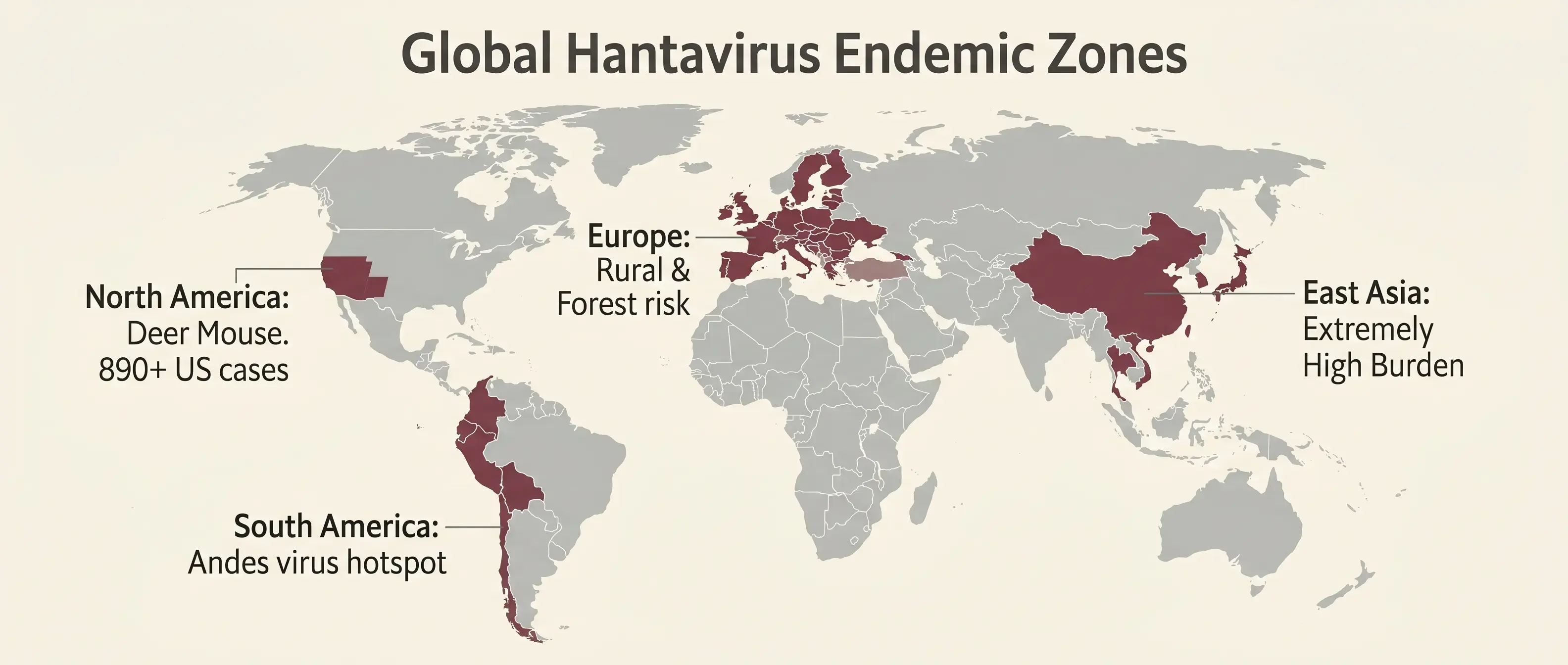
Hantavirus is tightly tied to its rodent hosts. Where specific rodent species live, the virus follows. The hantavirus map reflects this reality with clearly defined endemic zones.
North America
The US Southwest carries the highest historical burden. The Four Corners region saw the first US outbreak in 1993. CDC has recorded 890 confirmed US cases through 2023. Most cases occur west of the Mississippi. The reservoir is the deer mouse. CDC case data.
South America
Argentina, Chile, and Brazil form the Southern Cone hotspot for Andes virus. PAHO issued a heightened epidemiological alert for this region in December 2025. Travelers who did outdoor activities in these countries should monitor for symptoms. PAHO alert.
Europe
Finland, Sweden, Belgium, Germany, and the Balkan states report HFRS cases annually. Risk peaks in spring and early summer. Rural and forested areas carry the highest exposure risk. ECDC reports.
East Asia
China accounts for tens of thousands of HFRS cases each year. South Korea, Russia, and Japan also carry significant burden.
The hantavirus map integrates surveillance data from all regions, sourced directly from ECDC, PAHO, and China CDC Weekly.
HPS vs. HFRS: Two Diseases, One Virus Family
Hantavirus does not behave the same way everywhere. The strain and the region determine which disease develops.
HPS
Hantavirus Pulmonary Syndrome
Causes rapid lung failure. Fatigue and muscle aches appear first. Then, within days, the lungs fill with fluid.
Key Strains
Primary region: The Americas
HFRS
Hemorrhagic Fever with Renal Syndrome
Attacks the kidneys. Symptoms include fever, back pain, hemorrhaging, and acute renal failure. Generally less rapidly fatal than HPS, but severe cases still kill.
Key Strains
Primary region: Europe & Asia
The hantavirus map displays both syndromes separately by region and strain. A traveler returning from rural Chile faces a different diagnostic picture than one returning from South Korea. Understanding which zone you were in matters.
Authoritative Sources: Global Hantavirus Real-Time Updates
Cut through the noise. Track firsthand outbreak reports and risk assessments from top global health organizations like the WHO and CDC.
ProMED-mail (Program for Monitoring Emerging Diseases)
ProMED is the global standard for early warning of emerging infectious disease outbreaks and toxins. It provides real-time, expert-moderated alerts that are frequently the first to report new global health threats.
CIDRAP (Center for Infectious Disease Research and Policy)
Based at the University of Minnesota, CIDRAP offers highly authoritative, evidence-based news and policy analysis on infectious diseases. It is an excellent resource for tracking epidemiological trends and scientific literature updates.
WHO DONs (World Health Organization - Disease Outbreak News)
This is the ultimate global authority for verified public health emergencies. It publishes official, comprehensive reports on confirmed outbreaks, including specific strain tracking, transmission data, and global risk assessments.
US CDC (Centers for Disease Control and Prevention)
The premier US public health institute, maintaining the most extensive clinical database on hantaviruses. It provides definitive guidelines on prevention, symptoms, and detailed epidemiological statistics.
ECDC (European Centre for Disease Prevention and Control)
The core agency for infectious disease defense in the European Union. It produces rapid risk assessments and robust epidemiological tracking, which is particularly crucial for monitoring outbreaks with European links.
STAT News
A top-tier journalism platform focused exclusively on health, medicine, and scientific discovery. It provides deep-dive reporting, expert analysis on virology, and insights into public health responses.
Reuters Health
A premier global news agency renowned for its strict journalistic standards and rapid reporting speed. It delivers objective, real-time breaking news regarding the societal, governmental, and healthcare impacts of global disease outbreaks.
GISAID (Global Initiative on Sharing All Influenza Data)
Originally focused on influenza, GISAID has expanded to become the world's primary database for sharing genomic data on viruses, including hantaviruses. It is the essential source for tracking the molecular evolution and specific genetic variants of the virus during an outbreak.